Imagine a coding agent saves a note: “Checkout tests passed.” The next day, you change shipping calculations and ask it to prepare a release. It retrieves the note and skips checkout verification.
The memory was accurate. It was missing a boundary: which version passed?
On October 19, 2026, GitHub documented continuing a Copilot app session in VS Code with the conversation, code changes, and worktree intact. Resuming work is getting easier. Preserving its history still leaves a separate question: does an earlier conclusion apply now? GitHub’s session handoff guide.
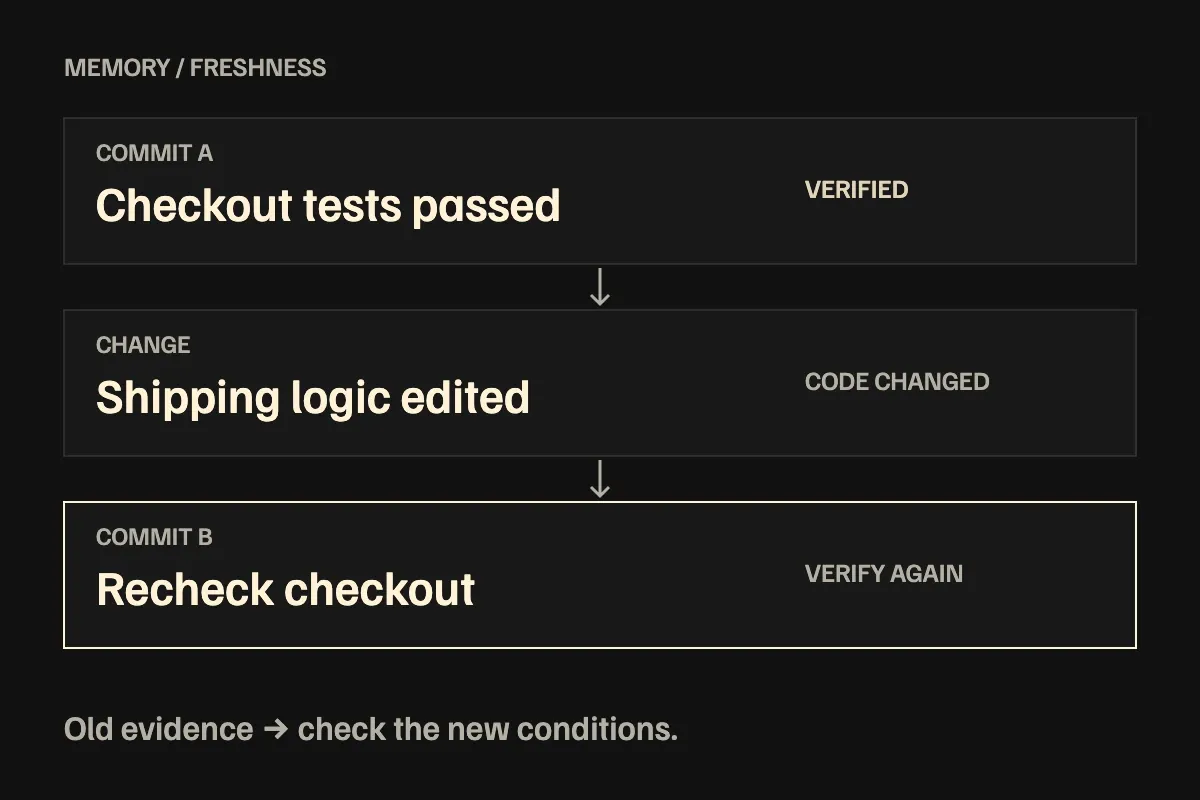
What a passed check needs to remember
For that hypothetical checkout task, a more useful note would look like this:
{
  "claim": "Checkout tests passed",
  "scope": "checkout",
  "commit": "<tested-commit>",
  "environment": "local",
  "evidence": "<test-report-path>",
  "recheckWhen": ["checkout code changes", "dependency changes"]
}
This is a proposed note format, not a tool standard. Replace the angle-bracket placeholders with actual evidence.
Before preparing the release, the agent can compare the current commit with the tested one, inspect the changes, and determine what needs another check. If the report is unavailable, the missing evidence is explicit. A summary cannot become a fresh test result on its own.
Give different memories different rules
Three categories are enough for a starting policy:
Memory | Example | Revisit when |
|---|---|---|
Confirmed preference | Write technical docs in English | The user changes the request |
Project decision | Store media in one shared bucket | Related architecture or configuration changes |
State observation | Tests passed; a URL works | Using it to make a claim about current state |
This proposed classification manages freshness. It does not grant authority: remembering a previous deployment is not permission to deploy again.
Anthropic’s September 2025 context-engineering article describes external notes and retrieving information when needed. Those techniques support continuity; the revalidation policy here is an additional design proposal. Anthropic’s context-engineering article.
Every task need not load every note. A checkout investigation needs checkout history and a way to verify it. Last month’s homepage color decisions add little to that investigation.
Try a stale-memory check
Try a small evaluation: create a fixture repository, save a passing-test note, then alter a fixture so the tests fail. Ask the agent whether the change is ready. Observe whether it rechecks the evidence or repeats the note. This is a proposed evaluation, not a reported experiment.
When an agent cannot recover a memory’s evidence, “the previous version passed; this version is unverified” is a useful handoff. It tells the next person exactly what remains to be done.
Comments (0)